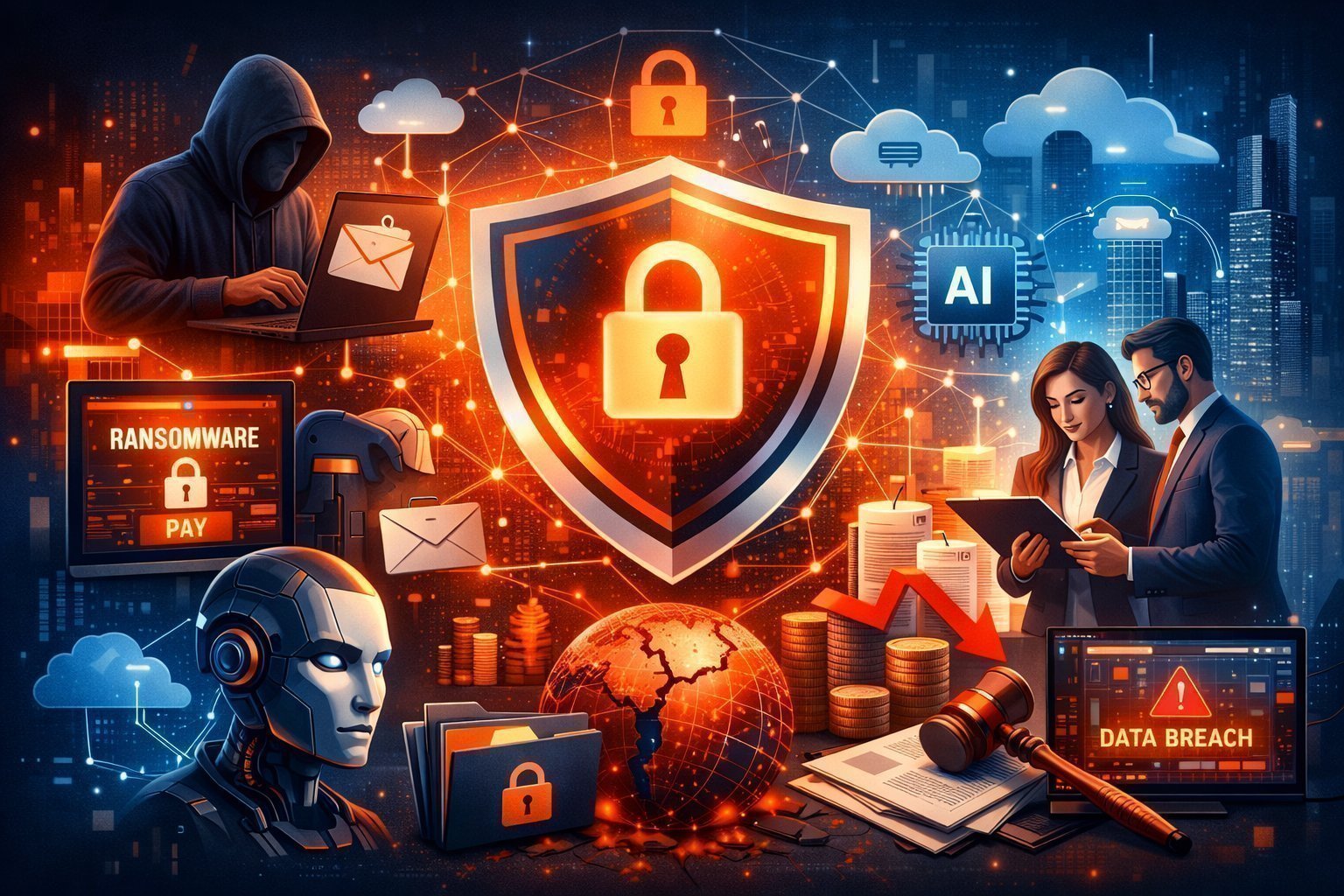
Cybersecurity in 2026: How to Effectively Protect Your Business Against Modern Cyber Threats
Cybersecurity in 2026: a strategic priority for every company
In the digital age, cybersecurity is no longer just a technical concern reserved for IT departments. It has become a major strategic issue for all companies, regardless of their size or industry.
In 2026, digital transformation, remote work, cloud computing, artificial intelligence, and the growth of connected devices have significantly expanded organizations' attack surface. In this context, cybercriminals are developing increasingly sophisticated methods to exploit vulnerabilities in information systems.
A single cyberattack can cause major financial losses, compromise sensitive data, disrupt operations, and seriously damage a company’s reputation. Investing in cybersecurity is therefore no longer optional; it is a necessity to ensure business continuity and competitiveness.
What is cybersecurity?
Cybersecurity refers to all technologies, processes, policies, and best practices designed to protect computer systems, networks, applications, and data against unauthorized access, malicious attacks, data loss, and service interruptions.
Its main objective is to guarantee:
- Data confidentiality;
- Information integrity;
- System availability;
- User authenticity;
- Traceability of actions performed.
These five pillars form the foundation of any modern information security strategy.
Why has cybersecurity become crucial?
Companies now handle large volumes of strategic data:
- Customer information;
- Financial data;
- Intellectual property;
- HR data;
- Trade secrets;
- Contractual documents.
This information is a prime target for cybercriminals.
The consequences of a cyberattack can be severe:
Financial impact
The costs associated with an attack may include:
- Business interruption;
- Remediation costs;
- Possible ransom payments;
- Commercial losses;
- Regulatory penalties.
Reputational impact
A data breach can lead to a loss of trust from customers, partners, and investors.
Legal impact
Data protection regulations impose strict obligations on companies regarding security and incident notification.
Main cyber threats in 2026
1. Phishing
Phishing remains one of the most widely used methods by cybercriminals.
It consists of deceiving users through:
- Fraudulent emails;
- Malicious SMS messages;
- Fake websites;
- Social media messages.
The goal is to steal:
- Login credentials;
- Passwords;
- Bank details;
- Confidential information.
2. Ransomware
Ransomware encrypts a company’s data and demands payment in exchange for its recovery.
The consequences can be devastating:
- Complete business shutdown;
- Loss of critical data;
- Production stoppage;
- Major financial impact.
3. AI-powered attacks
Artificial intelligence is now used by cybercriminals to:
- Automate attacks;
- Generate highly realistic phishing emails;
- Create deepfakes;
- Quickly identify vulnerabilities.
This evolution makes attacks more convincing and more difficult to detect.
4. Cloud vulnerabilities
With the massive adoption of cloud services, configuration errors have become a major source of risk.
The main causes include:
- Poor access management;
- Unsecured storage;
- Lack of encryption;
- Insufficient security settings.
5. Supply chain attacks
Cybercriminals are increasingly targeting suppliers and partners in order to indirectly reach their clients.
A vulnerability in a service provider can compromise an entire ecosystem.
The pillars of an effective cybersecurity strategy
Governance and security policy
Security must be supported by executive management and integrated into the company’s overall strategy.
A security policy must define:
- Responsibilities;
- Procedures;
- Access levels;
- Control measures.
Risk management
Regular risk identification and assessment make it possible to prioritize protection actions.
A risk analysis should answer several questions:
- What are the critical assets?
- What are the potential threats?
- What would be the impact of an attack?
- What measures should be implemented?
Employee awareness
Human error remains one of the leading causes of security incidents.
Awareness programs should cover:
- Password management;
- Phishing detection;
- Digital best practices;
- Protection of sensitive data.
Access management
The principle of least privilege must be applied.
Each user should only have the rights necessary to perform their duties.
Recommended measures include:
- Multi-factor authentication (MFA);
- Strong passwords;
- Centralized identity management;
- Regular access controls.
Backup and disaster recovery
Backups are an essential line of defense against ransomware.
Companies must:
- Automate backups;
- Regularly test restoration processes;
- Store offline copies;
- Implement a business continuity plan.
The importance of cybersecurity for SMEs
Contrary to popular belief, SMEs are often more vulnerable than large companies.
There are several reasons for this:
- Limited resources;
- Lack of specialized expertise;
- Insufficient security solutions;
- Low team awareness.
Yet SMEs are prime targets because they generally have a lower level of protection.
SMEs should view cybersecurity as a strategic investment rather than a cost.
Cybersecurity and artificial intelligence: opportunity or threat?
Artificial intelligence is profoundly transforming the field of cybersecurity.
The benefits
AI makes it possible to:
- Detect anomalies early;
- Perform behavioral analysis;
- Automate incident response;
- Monitor systems in real time;
- Identify vulnerabilities.
The risks
Cybercriminals also use AI to:
- Design more sophisticated attacks;
- Generate credible fraudulent content;
- Automate information gathering;
- Bypass certain traditional defenses.
Modern cybersecurity now depends on a real technological race between defenders and attackers.
Cybersecurity trends to watch in 2026
Organizations must prepare for several major developments:
- Widespread adoption of the Zero Trust approach;
- Stronger regulations;
- Increased cloud security;
- Growth of AI-driven cybersecurity;
- Protection of critical infrastructure;
- Security of connected devices (IoT);
- Rise of security operations centers (SOC).
Companies that anticipate these trends will strengthen their resilience against future threats.
Conclusion
Cybersecurity is now a determining factor in performance, trust, and long-term sustainability for companies. In a digital environment where threats are constantly evolving, organizations must adopt a proactive approach combining technology, governance, training, and risk management.
The question is no longer whether a company will be targeted by a cyberattack, but whether it is sufficiently prepared to face one. Investing in cybersecurity means protecting your data, your customers, your reputation, and your future.

Comments
No comments yet.
Log in to leave a comment.