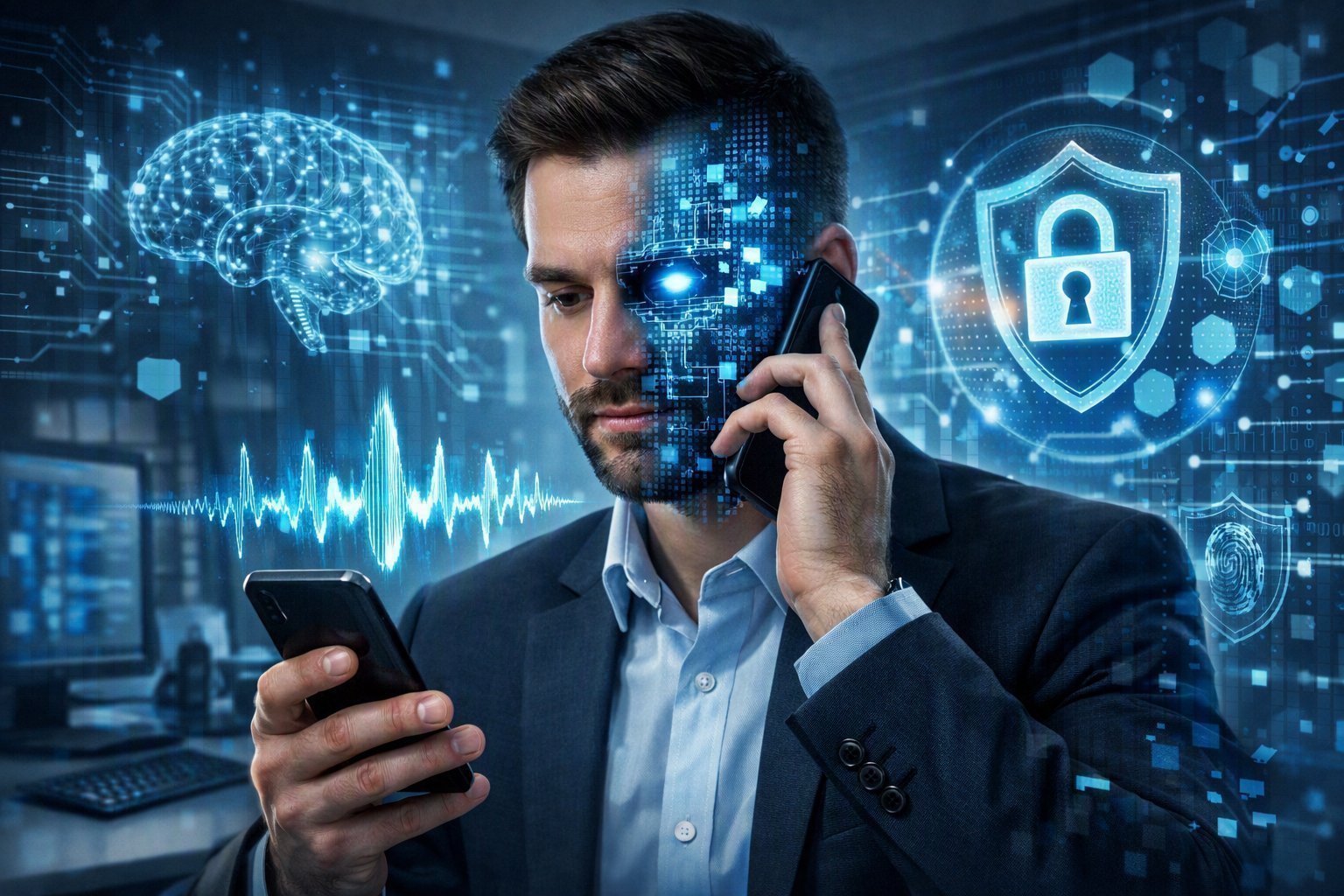
AI Scams, Deepfakes and Voice Cloning in 2026: How to Protect Yourself
AI Scams, Deepfakes and Voice Cloning in 2026: How to Protect Yourself
A call from a relative urgently asking for money. A WhatsApp message apparently sent by your manager. A perfectly written email from your bank. A video showing an executive asking you to make an urgent payment.
Everything appears authentic.
However, the person you see, hear or read may never have sent the message.
As artificial intelligence continues to advance, digital fraud techniques are evolving as well. Cybercriminals can now generate convincing text, imitate voices, create artificial images and produce realistic videos designed to deceive unsuspecting users.
Individuals, businesses, NGOs, public institutions, associations, schools, healthcare organizations and companies of every size are affected.
In 2026, one rule is therefore becoming increasingly important:
Seeing, hearing or receiving a message is no longer always enough to prove that it is authentic.
When artificial intelligence becomes a tool for fraud
Artificial intelligence provides tremendous opportunities in healthcare, finance, communication, education, industry, data analytics and automation.
However, powerful technologies can also be misused.
Fraudsters may use AI to:
- write highly professional emails;
- personalize phishing attacks;
- generate fake documents;
- create artificial images;
- imitate voices;
- produce manipulated videos;
- automate conversations;
- reproduce the communication style of an individual or organization.
As a result, scams that were once easy to recognize because of poor grammar and obvious mistakes can become significantly more convincing.
1. Voice cloning: when a familiar voice can no longer be trusted
Imagine receiving a phone call or voice message.
The voice sounds exactly like your manager, colleague, business partner or family member.
The person says:
“I have an emergency. Please send the money immediately.”
Or:
“I'm in a meeting. Make the payment now and I'll explain later.”
Your natural reaction might be to trust the request because you recognize the voice.
That is precisely the danger.
Modern voice synthesis technologies can create increasingly realistic artificial voices from audio samples.
Videos, interviews, voice notes and other content available online may also provide material that criminals could attempt to exploit.
The right response
Whenever a request involves money, passwords, confidential codes or sensitive information, never rely exclusively on the voice you hear.
Call the person back using their usual number or use another communication channel to confirm the request.
2. Deepfakes: can we automatically trust video?
A deepfake is an audiovisual file generated or manipulated using artificial intelligence to make someone appear to say or do something they never actually said or did.
Deepfakes can potentially be used to create:
- fake statements;
- fake testimonials;
- fraudulent institutional communications;
- fake advertisements;
- fake promotions;
- fraudulent investment opportunities;
- manipulated content involving executives or public figures.
A convincing video should therefore not automatically be considered absolute proof.
When information appears unusual, urgent or highly sensitive, verify whether it is also available through the official communication channels of the individual or organization concerned.
3. Phishing is becoming more professional
Phishing is a technique designed to persuade users to voluntarily provide confidential information or perform a dangerous action.
Criminals may try to obtain:
- passwords;
- OTP codes;
- banking information;
- personal data;
- confidential documents;
- access to business accounts.
Artificial intelligence can help attackers create well-written messages that are adapted to a specific situation.
You might receive messages such as:
“Your account will be suspended within the next few hours. Click here to verify your identity.”
“An invoice remains unpaid. Please review the attached document.”
“Your package is being held. Additional verification is required.”
“Your password expires today. Sign in immediately.”
These messages usually attempt to trigger two emotions: fear and urgency.
The more a message pressures you to act immediately, the more important it becomes to verify it.
4. Fake suppliers and fraudulent invoices
Organizations regularly receive invoices from suppliers.
A cybercriminal may attempt to imitate the email address of a legitimate supplier and send a message stating:
“Our banking details have changed. Please make all future payments to this new account.”
If the finance department fails to verify this information, several payments could potentially be made before the fraud is discovered.
Businesses, NGOs and public institutions should therefore establish a simple rule:
Any change to a supplier's banking information must be confirmed through a second communication channel.
Contact your usual representative using previously verified contact details.
5. WhatsApp and social media impersonation
WhatsApp, Facebook, Instagram, LinkedIn, Telegram and similar services have become essential communication tools.
They also create opportunities for impersonation.
Fraudsters may create:
- fake personal profiles;
- fake business pages;
- fake executive accounts;
- fake customer service accounts;
- fake job advertisements;
- fake competitions;
- fraudulent investment opportunities.
A professional photograph, company logo or several posts do not automatically prove that an account is legitimate.
Before sending money or sensitive information, verify the organization using its official website and established contact information.
6. Fake recruitment and employment opportunities
Job seekers can also be targeted.
A candidate may receive an attractive job opportunity accompanied by a company logo, professional PDF documents and someone claiming to represent the human resources department.
After several conversations, the candidate may be asked to pay:
- application fees;
- training fees;
- visa fees;
- equipment fees;
- recruitment fees.
A legitimate organization should be verifiable.
Before making any payment, check the company's official website, official contact information and whether the advertised position actually exists.
7. OTP codes: a few digits that can unlock your account
An OTP is a temporary code used to confirm a login or transaction.
It provides an additional layer of security.
However, that security becomes ineffective if you voluntarily provide the code to a fraudster.
A common scenario involves receiving a call such as:
“Hello, we're calling from customer support. A security code has just been sent to you. Please give us the code so we can cancel a suspicious transaction.”
In reality, the fraudster may be attempting to access your account.
Providing the code could allow the attacker to complete the login.
Remember
Never share your personal verification code with another person.
8. Who is affected?
Almost everyone.
Individuals
They may experience identity theft, financial fraud or scams involving fake relatives.
Businesses
They can be targeted through employees, suppliers, professional accounts or payment systems.
NGOs and associations
They may receive fraudulent communications pretending to come from donors, partners or project managers.
Public institutions
They may face phishing attempts, institutional impersonation or unauthorized attempts to access information systems.
Schools and universities
Staff, students and parents may all become potential targets.
Healthcare organizations
They must pay particular attention to protecting system access and confidential information.
Cybersecurity is therefore no longer an issue reserved exclusively for IT specialists.
It concerns everyone who uses a computer or smartphone.
9. Ten essential habits for better protection
1. Do not act simply because someone creates urgency
Urgent requests should actually encourage additional verification.
2. Confirm financial requests
Unusual payments should always be verified independently.
3. Check the full email address
The sender's displayed name can easily be copied.
Inspect the actual email address.
4. Do not automatically click links
Check the destination before opening a link.
5. Never share OTP codes
Even with someone claiming to represent a bank, company or telecommunications provider.
6. Use different passwords
A compromised password should not expose several accounts.
7. Enable multi-factor authentication
It provides an additional layer of protection.
8. Keep devices updated
Software updates frequently correct security vulnerabilities.
9. Verify sensitive information through another channel
For example, confirm an email request by telephone.
10. Train employees regularly
Technology alone cannot prevent every attack.
Human awareness remains a critical element of cybersecurity.
10. What should you do if you believe you have been scammed?
Speed matters.
If you have disclosed your password, change it immediately.
If you have provided banking information or made a suspicious payment, contact your bank or financial service provider as soon as possible.
If a business account is involved, alert your IT team or management.
Disconnect unfamiliar sessions and enable stronger authentication whenever possible.
Keep emails, screenshots, telephone numbers, transaction references and any other evidence that may help document the incident.
Building a new culture of digital trust
For many years, recognizing a person's voice or seeing them on video was enough to create confidence.
That is changing.
Artificial intelligence does not mean that we should distrust everything.
Instead, it means that we need stronger verification habits.
For important actions, a few seconds of verification can prevent financial losses, data breaches or unauthorized access to systems.
The rule is simple:
Verify before clicking.
Verify before sharing confidential information.
Verify before making a payment.
Cybersecurity is becoming a shared responsibility
Organizations must now combine technology, internal procedures and user awareness.
An effective cybersecurity strategy may include:
- secure access controls;
- multi-factor authentication;
- strong password management;
- regular data backups;
- endpoint protection;
- payment verification procedures;
- employee awareness training;
- incident response procedures.
Digital threats continue to evolve rapidly, and security practices must evolve with them.
Yeni Consulting supports businesses and organizations with digital transformation, infrastructure security and the implementation of technology solutions adapted to their activities.
In the age of artificial intelligence, effective protection requires a combination of technology, awareness and good security practices.

Comments
No comments yet.
Log in to leave a comment.